Monday, April 16, 2012

99 posts later, there are still lines being crossed...or not


Ninety-nine posts ago, What Would David Bowie Do? made its debut with a lengthy diatribe about England's ignominious departure from the 2010 World Cup.

It was an angry rant, with its bile composed of England's piss-poor performance in South Africa, their ejection by Germany yet again, by the fact it was written exceedingly early on a Monday morning and during an arduous daily train ride to a destination I was growing decidedly antsy about, and by virtue of me being in a generally foul frame of mind, the reasons for which are best left unmentioned.

Viewed from a better perspective, the root of my bateyness was the fact that during England's final 16 encounter with Germany, Frank Lampard's delightful 38th-minute chip had bounced off the German bar and across the line so far the ball ended up in a different post code. Millions watching around the world saw it cross the line, as did most of the 40,510 spectators inside the Free State Stadium. I missed it as I was, at the time, somewhere beneath the English Channel where technology has yet to find a means of relaying radio signals. As it transpired, I wasn't alone in missing it: Uruguayan referee Jorge Larrionda, his two assistants and FIFA's fourth and fifth officials had also blinked just as the ball crossed the line.

It is unfortunately circuitous, then, that WWDBD?'s 100th post should fall on the occasion of another refereeing howler, again involving a team featuring Lampard, albeit with the prolific midfielder being on the victorious side this time. Chelsea's second "goal" in yesterday's FA Cup Semi-Final against Tottenham is not one I, as a Blues fan, will be particularly proud of. But if I'm uncomfortable at the goal standing, referee Martin Atkinson should be hiding his head in shame at allowing such a comical decision to stand.

Larrionda is said to have exclaimed "Oh my God!" when he later saw a replay of Lampard's disallowed goal. I wonder how hard and jagged was the item Atkinson swallowed when he saw video of various Spurs and Chelsea players bundled together like newly-betrothed snakes as Juan Mata's shot bounced off the sole of Benoit Assou-Ekotto's boot, effectively still in play.

According to Harry Redknapp, the referee has at least copped to his mistake: “[He's] watched it now and says he feels worse than I do. I said, ‘I don’t think so’. But he says he feels bad," the Spurs manager said afterwards. “He knows he’s made a mistake and he says he’ll have a bad week as well.”

So here we go with wave upon wave of renewed calls for goal-line technology and shallow defensive comments about referees being "only human", and indeed some are. Some are also splendidly gullible.

The argument against technology, certainly, is no longer tenable. When there are so many cameras around the ground that players can be punished retrospectively for off-ball incidents, it seems nonsense that decisions can't be made instantly when a disputed goal is scored. Or not.

Introducing technology has nothing to do with messing with the traditions of the game or even challenging the authority of the man in the middle. It's just that the pace of football now, coupled with the level of scrutiny afforded everyone except the match officials themselves is such that without technology they are disadvantaged.

We shall never know whether, had the goal been disallowed, the 5-1 scoreline would have been any different. It's possible that Spurs could have rallied, and beaten Chelsea handsomely. England, had Lampard's goal stood, may have also gone on to trounce Germany (although only the most myopic England supporter would have expected that, given the team's abject displays in the three games prior).

The absence of technology to conclude irrevocably that a goal had been scored has left us, yet again with more questions about how good our referees are in another weekend of big clubs, big decisions and big mistakes. There also remains questions about the moral fidelity of players. Diving, "simulation" or just plain old 'cheating' has rarely been further from attention than as now. So is there a difference between Ashley Young winning his second penalty in a week through another challenge to Tom Daley as Britain's greatest diving hope, and a ball not crossing the line, the referee attesting that it did, and the player with a claim to the 'goal' wheeling away as if he'd just struck a blinder?

To be fair to Juan Mata, the rush of blood to the head after you've put the ball in the back of the net (or at least sent it in that general direction) will blind the player to all other rational thought. Wembley is a magical place, and it's not just English schoolboys who dream of scoring on its hallowed turf. Can you really blame Mata for celebrating having, in his mind, added his name to Wembley lore?

And what about John Terry - should he have offered to set Atkinson straight? His admission, later, that "I thought it hit me and stayed out" does beg the response "Well, why didn't you tell the ref, then?" but given the season Chelsea's players have had, least of all Terry, it would take a particularly unusual player to have not taken that "ghost goal". It's not, either, as if it killed the game. Spurs are made of stronger fibre than that, and the fact that they clawed one back via Chelsea's season-long gappy defence, shows they weren't - at that point at least - going to just put their feet up. Until, of course, tiredness crept in, heads dropped and Florent Malouda, of all people, poked home Chelsea's fifth goal, following Ramires' cool third and Lampard's spectacular fourth.

I'll take that 5-1 win over Tottenham, but in my heart I'll regard it as 4-1. It's still an impressive scoreline for a Wembley encounter. The only note of real discomfort is the small minority who chose to disrespect the memories of the Hillsborough 96 and Livorno's Piermario Morosini, who collapsed and died 31 minutes into his Serie B game against Pescara the day before.

Football is only a game. It has its flaws and imperfections, but it is only a game. Spurs fans will be smarting, but compared with an FA Cup Semi-Final played on April 15th, 23 years ago, they will at least be able to go on smarting about a poor piece of refereeing for the weeks to come, as opposed to mourning the loss of 96 fellow human beings who left their homes one morning to watch a football match, and never came back. And that is something no replay can ever explain and certainly no technology can ever revoke.


Saturday, April 14, 2012

Singing songs about the Southland

For all its 24-hour drive-through simplicity, America is a highly confusing place. And vast. In fact it is so confusingly vast that the region known as 'The South' only actually covers the bits at the bottom in the middle and on the right.

To the left of The South is, unsurprisingly, “the South-West”, and this includes states like Texas, New Mexico and Arizona. However, California, the most south-westerly state, is bafflingly not included as it is part of The West.

Florida is also in The South (even including the most southernmost point of the “contiguous” United States) and yet Floridians do not appear to consider themselves Southern in the same way their gun-owning, grits-eating, pick up-driving cousins do elsewhere below the Mason-Dixon Line. Probably because they're having too good a time at the beach.

In the midst of this puzzling geography is Alabama. A squat state just 250 miles long from top to the mere toe it dips into the Gulf of Mexico, it has borne the brunt of misconception about Dixieland, providing a shorthand symbol for clichés about dueling banjos, inbred policemen wearing mirrored sunglasses and dentally-challenged yokels threatening to induce porcine squealing.

What hasn't helped is Alabama's reputation for harbouring right-wing conservatism and the Klu-Klux Klan, but then again it has also been the powerful seat of the American civil rights movement. Still, given this history, it's no surprise that most tourists barreling along I-10 from California to Florida - and probably the only consistency in the southern states - will carry on through to the beaches and theme parks of "The Sunshine State" next door.

Compared with some of its neighboring states, Alabama lacks culturally iconic attractions, unless you are interested in Huntsville being "the rocket capital of the world" and built the rockets for Apollo 11,  that Montgomery - the state capital - was the birthplace of the Confederacy (and Nat King Cole), and that Hitler's typewriter is on display in the town of Bessemer.

Significantly more interesting is the contribution Alabama has made to The South's musical heritage. Muscle Shoals boasts one of the most famous recording studios in music history as well as being the birthplace of WC Handy, the "father of the blues", and Hank Williams - the pioneer of modern country music - was born in a small town on the outskirts of Birmingham. Alabama also featured in one of the most vitriolic exchanges of lyrical handbags between artists, with Lynyrd Skynyrd writing Sweet Home Alabama in response to Neil Young's Southern Man. The fact that two of the members of Skynyrd who wrote the song came from Florida and a third was Californian is neither here nor there. So, yes, southern, but not Southern.

Now, however, Alabama is being plonked loudly back on the musical map by a band who wears its Alabamian origins like a full-body Yakuza tattoo, and who have been described - by just about everyone - as the must-see band of the moment: Alabama Shakes.

With an unashamedly retro sound as sweaty as The South is muggy and mosquito-infested, the Shakes are comprised of the splendidly fruity vocals of former postwoman Brittany Howard and the rhythm section of bassist and co-founder Zac Cockrell, guitarist Heath Fogg and drummer Steve Johnson, a trio to match Cropper/Dunn/Jackson in their Memphis prime.

In a short space of time, the Alabama Shakes have built a reputation for stomping live performances of southern soul and blues-infused swamp rock, all of which provides the fabric of their wonderfully down-and-dirty debut album, Boys & Girls.

It's an album that could easily have been recorded in a single, 38-minute session, such is its no-nonsense feel. You'd be tempted to brand it 'lo-fi' until you realise just how ridiculous a description that is, given that back-in-the-day all albums were recorded without the embellishment of multi-tracking and ProTools, the musician's equivalent of CGI.

Such stripped-back authenticity is no affectation and, despite the obvious nods to Janice Joplin in Howard's throatsome singing or Creedence Clearwater Revival in Fogg's riffs (especially on Hang Loose), this is no pastiche, no parody, but a continuation of a musical style unencumbered by contemporary garnish.

Hold On, their debut single, represents this perfectly, building rhythmically with a swelling chug that emerged from an on-stage improvisation ("We threw out that riff," recalls Cockrell, "and Brittany started singing along, and the crowd started singing with her like it was a song they already knew.").

Like all good soul bands, the singer draws the focus of the song, and none more so with Brittany Howard than on I Found You and I Ain't The Same. If, however, you try and ignore the obvious aural resemblance to Joplin, you recognise greater similarities to Otis Redding, in phrasing and the topography of her pitch. You Ain't Alone, in particular, pays inadvertent tribute to Try A Little Tenderness, pulling in the intensity of Joe Cocker or even Led Zeppellin into the bargain. The track is, says Howard, "a slice of the real".

In their early days, the band covered Zeppellin live, so the site of Heartbreaker on the track listing of Boys & Girls did create some expectation, but this particular tale of romantic charlatanism is instead a gloriously rich stab of triple-time R'n'B which reaches its rasping denouement with a pounding organ to match the rancor of the reminiscence.

It would be wrong, however, to look upon Boys & Girls as a musical museum: Rise To The Sun could easily be the product of Alex Turner's southern American cousin, while there are numerous moments on the album which remind of another much-hailed debut flying the Confederate flag, Youth And Young Mahood, the Kings of Leon's 2003 entrance. The Fallowill clan created an enjoyably confounding blend of quirk and rooted tradition (and were also considered the critics' breakthrough darlings), which the Alabama Shakes replicate with On Your Way and the eerily short Goin' To The Party.

Of course, since 2003, the Kings of Leon have spectacularly risen, and spectacularly come to an abrupt halt. The Alabama Shakes will be conscious of not repeating the same trajectory, and that may require the  development of their repertoire and writing acumen. Boys & Girls is a tremendous debut and a relief to anyone worried that the prevalence of Simon Cowell and his oeuvre has in some way brought about the end of both live music and music built on the simplicity of a voice and three instruments. For the good of us all, the Shakes need to come back with a sophomore effort to reassure the casual listener that this is not a flirtation but a long-term relationship.


The Alabama Shakes blow the lid off Austin during SXSW 2012


Friday, April 06, 2012

The difference between Fab and fabricated

Can you hear that? That's the sound of shuddering at the idea of James McCartney, Sean Lennon, Dhani Harrison and Jason Starkey forming a band.

Not that they would be bad - quite the opposite. However...

Talk of The Beatles being 'reformed' by their offspring - arguably the head-on collision between a Hollywood remake and a tribute band - was sparked earlier this week when James McCartney, the 34-year-old son of Sir Paul, suggested - and I stress, suggested - in a BBC interview that a Beatles reboot might be fun.

McCartney Jr may have ill-advisedly answered a question by saying that he, plus the younger Lennon and Harrison, might be up for it, with either of Ringo Starr's drumming sons Zak or Jason yet to be canvassed. It was only a suggestion but it nonetheless struck a chord of terror.

Surely a band trading off the coincidence that each of its members' fathers were in the greatest pop band in recording history is a recipe for disaster? I'm sure they've been friends since childhood, but that wouldn't give forming a band any more legitimacy.

Talent obviously runs through the respective McCartney, Lennon, Harrison and Starr/Starkey bloodlines: James McCartney is currently promoting his own, emerging solo career while sister Stella has become one of the world's leading fashion designers (other half-siblings Heather and Mary keep low profiles). Julian and Sean Lennon have both enjoyed varying degrees of music success, though the former hadn't been heard of much since early hits in the 1980s before re-emerging last year with a new album. Ringo'a sons Zak and Jason became professional drummers, but only Zak has enjoyed any degree of prominence, touring as drummer for The Who and playing for both Paul Weller and Oasis.

And then there's Dhani Harrison - who looks and sounds uncannily like George - and who made his professional debut as a guitarist on his late father's final album, Brainwashed. Since then his career has been developing relatively modestly, with guest appearances and collaborations here and there, including the formation of Fistful of Mercy with Ben Harper and Joseph Arthur a couple of years ago.

Harrison has also been involved in the band thenewno2, from which a cryptic tweet appeared this week which many suspected was from The Quiet One's son himself, nixing the whole idea. That hasn't prevented a media frenzy at the idea of a Fab Second Coming, with some wag already naming them the 'Mop Tots'.

"If they want to play together privately to entertain themselves and their friends, that would be terrific," offered Beatles biographer Ray Connolly in the Daily Telegraph yesterday, who then helpfully pointed out the size of the shadows are probably perfectly aware of standing in: "Forged by the accidental cross-seeding of extraordinary talents in a post-war environment of social change, [The Beatles'] grip on the world’s imagination cannot be replicated. All the elements that came together then and helped create them and their myth cannot recur."

The familiar-looking cheekbones of Coco Sumner
We should be now well used to musical offspring making a go of it themselves, being well inside the second age of rock and pop.

Bob Dylan's son Jakob was one of the first of his generation of showbusiness kids to embark upon a prominent music career of their own, with others like Ziggy Marley, Rufus and Martha Wainright, Dweezil Zappa and more recently Coco Sumner joining the family firm. 

Comparable, in terms of parental reputation, to this story, Lisa Marie Presley has made several attempts at a music career, with her 2003 debut album To Whom It May Concern even reaching No.5 in the Billboard album chart (and who has been working with the omnipresent T-Bone Burnett on a new record due this year).

Others, however, have steered well clear: Duncan 'Zowie Bowie' Jones adopted his father's real surname and took up film directing (what would David Jones do...?), various members of the Jagger brood have found their way into fashion, while many more have simply found something altogether less laden with expectation to forge careers upon.

But what if McCartney, Lennon, Harrison and Starkey did give it a go, and Beatles: The Next Generation became reality? A charity project, may be (and hats off, too - no better way to leverage the ancestral arms). As long as we didn't end up with a Beatle-version of S Club Juniors, the "franchised" S Club 7 spinoff. Because we would not be talking about a Toytown pop group, but scions of a band to which few will ever hold a candle. Trying to compete with that legacy for any band, let alone The Beatles' children, would, I'm afraid, only end in tears.


Thursday, April 05, 2012

If you think that was Messi, there could be worse to come

They call Old Trafford football's "Theatre Of Dreams" but by comparison to Camp Nou - F.C. Barcelona's home ground - the Manchester United stadium is little more than a community playhouse.

Just over a month ago I fulfilled a long-held ambition to see a match at the Catalan giants' jaw-dropping ampitheatre, watching Barça play La Liga minnows Gijon.

To tell you the truth, it wasn't the greatest game I've ever seen: Pep Guardiola had rested several of his star players, including the mercurial Lionel Messi - who, just a few days later, became the first player to score five goals in a Champions League game as they battered Bayer Leverkusen 7-1. Still, they managed to beat Gijon 3-1 and, in so doing, provided an abject reminder that even when below par, they are currently the world's greatest football team.

Which doesn't leave me brimming with confidence about the forthcoming Champions League Semi-Final, in which Messi and amigos will take on Chelsea. By their standards, Barcelona haven't exactly been firing on all cylinders this season. But considering the Leverkusen scoreline, it will be an apocalyptic challenge for the Blues who have, for much of the season been even below being below par.

True, things have picked up since Robbie Di Matteo was installed with the condescending title of "interim first-team coach", finding the means to communicate and motivate his players in a way the hapless André Villas-Boas apparently couldn't.

There has clearly been a new confidence about the team, notably with Fernando Torres looking like his former self - even scoring a goal, God forbid! - and the walking liability that was David Luiz starting to resemble a half-decent centre-half.

These are, however, straws I'm clutching at: the confidence that led to Torres scoring against Aston Villa the other week was undermined by the same back four defensive frailties that let two in. And were it not for the outstanding Petr Čech - who has, frankly, kept Chelsea in more games this season than any of the outfield players - the Villa game, like so many others, could have ended very differently.

Last night Chelsea struggled against a determined 10-man opposition in Benfica. With John Terry disappearing through a worrying rib injury that could leave him out of a packed run of games, Chelsea will tire even further in their build up to the first Semi-Final leg against Barcelona. By the time Barça arrive at Stamford Bridge on April 18, their opponents will have played Wigan and Fulham in the space of two days, and then Tottenham at Wembley in a FA Cup Semi-Final which kicks off only 72 hours before the Barcelona game gets underway.

The fear is that the Catalans - and, specifically, Messi - will just cut through Chelsea like a hot knife. Pessimistic or realistic? You decide. Di Matteo is doing something right and, were it not for the twisted logic of Abramovich managerial strategy, should be considered as Chelsea's permanent manager on the scant basis of the tactical and man-management prowess he has demonstrated over the last month.

The likeable Italian is saying all the right things in declaring: "It will be a combination of playing to our strengths and being aware of theirs," but in recognising the Messi danger, adding: "we have to play our game and play to our strengths."

Good managerspeak, but those strengths aren't obvious, even after a month of re-emerging confidence. Torres is looking brighter, but he's still not the lethal weapon he once was; Daniel Sturridge is blowing hot-and-cold; Didier Drogba is, only when his mind is in the right gear, potent; and Saloman Kalou - who has remained a Chelsea player as inexplicably as the crocodilian family survived whatever wiped out dinosaurs - may have been given more opportunities to play by Di Matteo, but he's still not a forward to give Barcelona defenders too much concern.

Pyschologically, of course, there will be a lot to fire Chelsea up: their 2009 Champions League Semi-Final against Barça was a disgraceful demonstration of refereeing by Norwegian Tom Henning Ovrebo. Who knows whether his defiant ignorance of clear penalty shouts would have led to Chelsea beating Barcelona, but two years ago Chelsea could have been considered equals to Barcelona in many aspects of their game.

That match ended in farce, with a flip-flop wearing Didier Drogba unleashing X-rated invective on an unsuspecting TV camera, and Michael Ballack applying himself to Ovrebo's ankles like an enraged pit bull, such was the understandable vexation almost everyone - Chelsea players, fans and neutrals alike - felt over the Norwegian's inept refereeing.

God only knows how Jose Mourinho would have reacted if still in charge of Chelsea. Given his own history with Barcelona - as both assistant coach and opposing manager - and his predilection for entertainingly explosive histrionics, it is possible he would have simply detonated, cartoon-style, as the only reaction left in his bag of tricks.

Naturally he has an opinion on the outcome of the Chelsea-Barcelona tie, with his Real Madrid a contender for the final itself if they can beat Bayern Munich: “Let me be honest, I don’t think the final will be a Real Madrid-Chelsea final,” Mourinho said on the prospect of an emotional and thrilling meeting between his current and former club.

Typically Mourinho, his conjecture didn't appear solely based on form: "It could be Bayern versus Barcelona, I just don’t think it will be Real Madrid versus Chelsea - and we know why.” Was this a nod-and-a-wink to conspiracy theories that Barcelona are afforded favour in the Champions League? Surely not, the cheeky scamp...

The Chelsea players will be - or at least, should be - fired up for righting the wrongs of that match in 2009: “Everyone’s got unfinished business with Barcelona,” according to Frank Lampard. But even he is realistic in what he'll be up against. "[Barcelona] are the greatest team in the world. They have been and they still are. That game is still in our minds, but this is a different year and we have to try to beat them. They’ll be favourites but we have got belief.”

No doubt, but even the most zealous Chelsea optimist will have to concede that they'll need more than just belief to beat Barcelona over two legs.

Tuesday, April 03, 2012

Going (Back) To California


The mountains and the canyons started to tremble and shake
As the children of the sun began to awake.
(Jimmy Page & Robert Plant; Superhype Publishing, Inc. All rights administered by WB Music Corp., ASCAP.)


California has long been the musician's muse. There are more songs about the Golden State than all the other locations enshrined in song put together. Its southern stretches of seaside sand inspired The Beach Boys and its desert wilderness inspired U2; the 'NoCal' coastal towns of Santa Cruz and Big Sur inspired an entire album by The Thrills; both the Chili Peppers and Tom Petty sang of the pitfalls that can bring the Californian dream to an end; San Francisco provided Tony Bennett with his signature piece, while the genius that is Randy Newman wedged tongue firmly in cheek to extoll the virtues of the state's chaotic love-it/hate-it focal point, Los Angeles.

On the City of Angels' topographic outskirts, the Laurel and Topanga Canyons respectively slice huge grooves through the Hollywood Hills and the Santa Monica Mountains. Within them reside, still today, remnants of the counter culture movements who set up camp in these mystic glacial cut-throughs in the mid-1960s, and smoked a lot of, uh, stuff.

As Barney Hoskyns' highly entertaining tome Hotel California: Singer-songwriters and Cocaine Cowboys in the L.A. Canyons - 1967-1976 recounts, this was a time of communal creative endeavour; Canyon homesteaders like CSN&Y, Joni Mitchell (who still has a place today in Laurel Canyon), James Taylor and Jackson Browne produced some of the era's finest folk-rock with songs, mostly about loving each other, which apparently went on a lot in LA's most swinging neighborhood.

Around the same time as all this was going on, three boys were born - albeit four years separating them - in the Midlands of England. Nigel Clark, Andy Miller and Mathew Priest would grow up to form a band with an ironic name, Dodgy, and they would be a fixture of the endless summer that seemed to expand through the mid part of the 1990s as part of the extraordinary cultural movement that was Britpop.

The trio would make their breakthrough in 1993 with a sunshine anthem, Staying Out For The Summer, but would remain - along with Cast, Kula Shaker, Catatonia, The Boo Radleys and others -  glittering sparks in the dust tails of 'Cool Britannia's biggest comets, Oasis, Blur and Pulp.

Nevertheless, Dodgy would be integral to this new era of guitar-rooted indie pop and its wholesale plundering of parental record collections. As 17 years of Tory rule came to an end, and 'New' Labour rolled in, we were enjoying ourselves. Hedonism was back: this was the height of Good-time Britain - when lads could be lads, and girls could be lads too, and Loaded magazine captured the zeitgeist in all its good, bad and ugly forms.

Dodgy's particular corner of the party would continue in 1996 with Good Enough, about as enjoyable a summer singalong as Alright by Supergrass or any one of a number of VW camper van favorites around that time. With its sun-kissed, tropical promo echoing the Caribbean video japes of another threesome, The Police, more than a decade before, Good Enough was perfect for a summer in a resurgent Britain, the kind of hit that finds its way up window cleaners' ladders as well as blasting across muddy, tent-infested farmland.

Free Peace Sweet, the album which spawned Good Enough, found the band exploring influences like The Who (none more so than on Jack The Lad), but the hits seemed to dry up and with it, the appearances on Top Of The Pops and Saturday morning kids TV subsided. In 1998 vocalist Clark went solo, leaving Priest (comedic, porkpie-hatted drummer, band spokesman and Never Mind The Buzzcocks favourite) and guitarist Miller ('The Quiet One™') carried on as part of a largely unremarkable five-piece, which fizzled out itself.

Drawn together by a mutual friend's funeral,  Clark, Miller and Priest reformed in 2008, initially to play live and then to start work on new material.

And so, after four years of gigging and writing, Dodgy have returned to the fore with Stand Upright In A Cool Place. It's a grown-up, party's-over album reflective of three men in their early 40s (Priest, with his avuncular, greying beard, now looks a lot like perennially middle-aged England cricketer Mike Gatting) - considering what they have, what they had and what is still left to go after.

A delightful mix of pastoral folk-rock and wistful melodies, Stand Up is seeped in the music that came out of those stoner homesteads in southern Californian more than 40 years ago. But unlike the LA canyon folk who purposefully dialed out of convention, Dodgy are embracing it in their middle age.

The VW camper has been sold and its proceeds spent on bedding plants and a kitchen extension. But not without some regret of the loss of youthfull opportunities and past relationships, as expressed on Shadows, Did It Have To Be This Way and What Became Of You.

Only A Heartbeat is another consideration of separation, but could have been plucked from John Lennon's Double Fantasy - largely because of Clark's uncanny vocal resemblance to Lennon (take note, Liam). If this gives the impression of a tendency towards the melancholy - well, OK, it does. It's a badge of honour all of us over the age of 40 have earned the right to wear.

Stand Up is not all acoustic guitars and Fleet Foxes harmonics, either: while we could do without the woodland sound effects on Raggedstone Hill (you don't need the sound of woodpeckers pecking and twigs snapping underfoot to set the rustic scene), it progresses from gentle folk into grungy yarn about a Malvern monk finding love in a fair-skinned forest saucepot. At almost seven minutes long, it is almost in prog territory (perhaps even a companion to The Lady Lies on ...And Then There Were Three by Genesis) in its storytelling. It's also the most complicated track on the album, an enjoyable departure from the melodic simplicity elsewhere.

The last of Stand Up's eleven tracks is its most deceptive. Happy Ending suggests closure but instead mocks an unidentified character for not being able to "stand a chance...and you never did", berating this poor individual for underachievement and unfulfilment. There is no explanation whom its about, but the suspicion is that this is a mild form of self admonishment, Dodgy giving itself a hard time for not doing as well as it could have done in the past.

The paradox is that Happy Ending is closure to an album which you would be hard pressed to call happy, but which is a still a superbly joyful return from a band who, when the Britpop wave first washed them ashore, struggled to be seen as anything other than good-time party band for festivals. Perhaps Stand Upright In A Cool Place will afford Dodgy the spotlight they weren't ready for almost twenty years ago. It is, after all, a fantastic record.

Monday, March 26, 2012

Trip Advice


1968 was the year things went totally mad. Like Syd Barrett, for example. Stanley Kubrick released 2001: A Space Odyssey, an Emperor's New Clothes if ever there was one - two-and-a-half hours of preposterously overblown quasi-religious hokum about foraging Neanderthals, homicidal computers, apes and monolithic objects appearing from nowhere. Mad.

1968 was the year the film industry thought the world needed a movie called She-Devils On Wheels. It didn't. It was also the year The Byrds were Eight Miles High (nudge-nudge, wink-wink) and The Doors recorded a series of poems over a 25-minute piece of music called Celebration Of The Lizard. 

1968 was also the year that The Monkees over-extended their fan appeal by making Head, a totally bonkers film co-scripted by Jack Nicholson and Bob Rafelson, who had created the band in the first place. For all its pretend tripping and, frankly, unintelligible surrealism, it included some of the Fabricated Four's best music, including Porpoise Song, written by Carole King and Gerry Goffin. And it's not that bad.

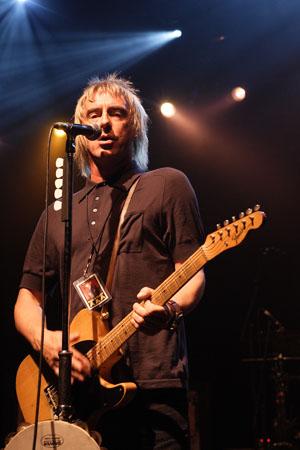
Paul Weller was ten-years old in 1968 and clearly had his ears wide open. Of all the many goofy things that emerged that year, it's possible that one album made its mark on the young Surrey schoolboy more than any other: Ogdens Nut Gone Flake. The Small Faces' 40 minutes of madness contained Steve Marriott's gawblimeycockerneesparrer novelty Lazy Sunday ("'Ello Mrs Jones, 'ows your Burt's lumbago?"), the big rocker Afterglow (Of Your Love), and a lot of very daft "hello trees, hello clouds, hello sky" psychedelic wigout material interlinked by the bizarre English language-mangling comedy act Stanley Unwin. Thankfully, Weller has never tried to ape ONGF too literally.

When Weller formed The Jam at Woking's Sheerwater School in 1974, it wasn't to the prog rock of the time that the teenage Modfather turned, but to The Small Faces, The Kinks, The Who and the harder edges of R'n'B from the decade before. The Jam then rolled Mod and Punk ethics into a tight ball of social conscience, which was the only element carried through to the sockless, Weejun-wearing, pastel sweater-draped effete of The Style Council, which took Weller on a soul and R'n'B-infused seven-year run of anti-Thatcherist bile.

When he returned in 1990 with his criminally overlooked and self-titled debut solo album, Weller drew on some of those musical eccentricities from his youth, mixing in with the sounds of the latest Summer of Love and the woozier elements of his more recent past, such as The Style Council's radio hit The Long Hot Summer (listen to that closely followed by Above The Clouds to see what I mean).

(Dean Farrell)
Now, 22 years into his solo career, Paul Weller is still building his magpie's nest with influences from the here, the now and the then. Sonik Kicks is Weller's 11th studio album and his third in four years (Why? "Well, you have to, at my age," he recently quipped to The Times). It's an output few of his peers seem capable of or are willing to replicate.

A third installment in his journey of free-spirited expression, following the pastoral England of 22 Dreams and the boppier Wake Up The Nation, Weller doesn't fall back on ceremony with Sonik Kicks. In short its probably his best-ever solo album when taken on the sum of its parts. 

At 53 it would have been easy for Weller to knock out another Wild Wood or Stanley Road, full of crowd-pleasing rockers and lush acoustic ballads. But like few others in his peer group - and perhaps even only Elvis Costello fits this description - Weller continues to rummage around his musical box of Lego bricks to see what else he can come up with that is meaty, beaty, big and bouncy, and which dips either a toe or both feet in the 60s without resorting to Austin Powers pastiche. 

Sonik Kicks finds Weller carefree and stridently upbeat at work. Happily dismissing contemporary chart influences, he tastes from as diverse a reference set as Lou Reed's Metal Machine Music, the polite Englishness of Nick Drake and the eccentric Englishness of Pink Floyd's See Emily Play.

From the off, the trancing, psychedelic funk of Green and its metronomic electronic pulse chugs like Weller's From The Floorboards Up on As Is Now, instantly defying anyone of Weller's age group to put Sonik Kicks on as dinner party background. Because that would be a waste of good ears.

Sonik Kicks deserves attention for its sheer variety and self-assured maturity. It's an album that one moment is about jangly two-minute pop songs like The Attic (featuring Graham Coxon and Noel Gallagher) and That Dangerous Age (a tongue-in-cheek swipe at men of a similar age to Weller himself), and next the frantic ska of Kling I Klang, a sub-conscious essay about strife in the Middle East, which somehow manages to hark back to Jacques Brel and Scott Walker's Jacky in the process.

There is more psychedelia with Drifters, which takes a turn down Tarantino Boulevard with a crazy thrash of Dick Dale reverb, a flamenco rhythm and wiggy strings along with synthesised beeps and  whoops like those used for sound effects in Brains' laboratory in Thunderbirds. There's more of that on Sleep Of The Serene, a short link between Kling I Klang and By The Waters, one of those dreamy acoustic guitar numbers Weller does so well.

For all his mod-punk sensibilities, Weller is sometimes at his best writing songs like You Do Something To Me, You're The Best Thing and Wild Wood, and By The Waters deserves to join them in Weller's perennial soundtrack to English riverside picnics, warm summer sun finding its way through blades of long grass. The Style Council's Long Hot Summer was another one of those humid August afternoon classics, and Weller returns to that vibe with Study In Blue. It starts out as a slightly gooey soul duet with Weller's new wife Hannah Andrews (sounding eerily like former partner Dee C. Lee) before oozing into a dubby trip that, were it not for the fact Weller has declared himself cleaner than a hospital door handle, would have you swearing that it had been written with a little help from nature's herb garden.

It's quite possible that the twentysomething Andrews and their infant twins John Paul and Bowie (hats off!) have given Weller a new confidence. Or maybe the adventure with which he goes about Sonik Kicks stems from the sort of trip you only get during the opening months of a new relationship, or of becoming a parent. But like the dopey romantic running along the road shouting "I'm in love!" to passing strangers, Weller jumps blindly from bold to brassy with each track. Dragonfly is one of the best songs he's written in years, another trippy track built up from a wall of noise that would be the perfect companion to Gallagher's AKA... What A Life! (indeed Sonik Kicks and Noel Gallagher's High Flying Birds share many tonal similarities).

Its here you realise that for all that nonsense a few years ago between Blur and Oasis for Britpop supremacy, there was already someone sat on that particular throne. Odd, then, that echoes of both bands (as well as personnel) ring through on Sonik Kicks, such as the Beetlebum-like Paperchase and When Your Garden's Overgrown, another stroll through Blur country (End Of The Century anyone?).


In 35 years as a fan I can honestly say I've never seen Paul Weller smile. Look back at any photograph over his career and you'll see that same, mildly batey look. It's not an angry expression, just one you'd call stony-faced, like Robert De Niro.

Sonik Kicks IS Weller smiling. It is even Weller content. It is certainly Weller laid more emotionally bare - and comfortably so - than at any time in his career.

Which brings me to the closing track of Sonik Kicks, Be Happy Children. Opening with a synth line straight from Zoom by Fat Larry's Band, it is perhaps the most conventional track on an otherwise unconventional album. It's a big, Motowny ballad, featuring two of Weller's seven children - Leah on vocals and a soundbite of seven-year-old Mac - and pays tribute to his late father, John. Weller Senior died in 2009 from pneumonia, having nurtured his son's career from the beginning - an origin that began with the young John Weller (before changing his name to Paul) getting an electric guitar for Christmas 1970.

Be Happy Children draws the 'regular' version of Sonik Kicks to an end, but if you shell out for the 'deluxe' edition, there is a coda worth the extra money alone: Devotion. Written for a BBC film last year about the Munich air crash that killed Manchester United's 'Busby Babes', its original version was suitably melancholy.

On Sonik Kicks, however, it draws on the album's warmth, rearranged around a 'travelling' guitar rhythm and very similar to Gordon Lightfoot's Early Morning Rain (which Weller himself covered on his Studio 150 collection). Here, Weller gives Devotion a happier, clappier Harry Nielsson vibe and a gentle, Laurel Canyon golden glow. While it may have been deemed surplus to the 'regular' version of Sonik Kicks, it is the perfect finale to an album that tests expectations without straying too far. Which is a sign of composed maturity in itself.

Saturday, March 24, 2012

The real Great Escape


Only we Brits - and, specifically, the English - could choose the title music from a film about a wartime failure as a means of bolstering support for our frequently beleaguered national football team.

But whenever England play, there they are, up in the stands with their big bass drum, tuba and trumpets, 'entertaining' fellow supporters with their oh-so ironic rendition of Elmer Bernstein's theme from The Great Escape.

You'd have thought - or, at least, hoped - that by now someone would have tapped the self-proclaimed 'Official England Supporters Band' on the collective shoulder and reminded them that the music they are playing comes from a movie about the attempted mass exodus by 200 downed Allied airmen from a seemingly escape-proof German prisoner-of-war camp, which ended pretty badly for all but three escapees.

The other aspect of this well-intentioned but witless irony is that England's performances, especially in tournaments, are as predictable as the fact that when there's a bank holiday in Britain one of the broadcasters will trot out John Sturges' 1963 film. Is there any living person in the United Kingdom today who has never seen it? I somehow doubt it.

The Great Escape, like The Dambusters, 633 Squadron and countless others, is a stirring tale of wartime derring-do and stiff upper lips, of the kind Britain took great pleasure in glorying to ensure no one ever forgets that without such lantern-jawed bravery, Harry Hun would never have been defeated and Europe would be still under the jackboot's murderous grip today. On top of all that, The Great Escape formed a barrage of war movies in the 1960s and 70s - like The Dirty Dozen and the brilliant crime caper Kelly's Heroes - which brimmed with the biggest Hollywood stars of the day.

Here, Steve McQueen headlined as the über-cool Hilts (who can't keep himself out of the solitary confinement 'Cooler') along with James Garner, Richard Attenborough, James Coburn, Donald Pleasence and, naturally, Charles Bronson in his usual role of humourless Pole.


Although based on a book by Paul Brickhill, an Australian Spitfire pilot who had been a prisoner at Stalag Luft III, The Great Escape bears very little resemblance to the actual events which took place on the night of March 24-25, 1944. For a start, there were no Americans involved in the real escape. This is something of a handicap when you're trying to get backing for a Hollywood movie losely adapted from real events. And at no time did any of the Stalag Luft III PoWs attempt to ride their way to Swiss neutrality by vaulting a motorbike over a barbed-wire frontier fence. Not that Hilts actually succeeds in doing so.

In reality, the real escape was an even more daring challenge. Stalag Luft III was regarded by the German hierarchy as a state-of-the art facility. Built under Luftwaffe chief Herman Göring's direction, it was located near the town of Sagan, in what is now Poland, on the basis that the ground underneath it would be unsuitable for tunneling. Such was the Germans' hubris about keeping prisoners locked in that the camp enjoyed a relatively convivial atmosphere, run by the German air force, rather than other more brutal environments controlled by German army units. The guards were mostly older conscripts or injured combatants, and prisoners enjoyed reasonably good treatment, from food to accommodation. However, this 'soft' reputation didn't make it any less a prison, or diminish the intentions of those incarcerated within it to break out.

In the spring of 1943, an RAF officer, Squadron Leader Roger Bushell (who became Richard Attenborough's Roger Bartlett in the movie) called together an escape committee and determined that "Three bloody deep, bloody long tunnels" should be built in the hope of freeing as many Allied pilots back into the war effort.

For almost a year the prisoners dug their tunnels 30 feet below the ground - deeper than escape tunnels in other camps - finding novel ways of making the excavated earth disappear throughout the camp grounds. That didn't stop the Germans from rumbling that something was up, but they never found out exactly what. Even deporting suspected ringleaders to other camps didn't to deter the nightly digging.

With German suspicions growing at the beginning of 1944, as soon as the final tunnel was ready and a moon-free night would be on offer to provide cover, 200 selected prisoners out of the 600 involved in the tunneling made their break for freedom.

In the end 76 actually made their way successfully out of the tunnels, a 77th prisoner being spotted by guards who raised the alarm. By then, the others were already on their way through snow on one of the coldest nights in that part of Europe for more than three decades. Panic stations raised,  the Germans dispatched all available forces to recapture the escapees. Three did, however, get away - two Norwegians and a Dutchman. But such was the bruise left by the other 73 breaking free that Hitler ordered each of the recaptured prisoners to executed, despite protestations from senior officers reminding him of the Geneva Convention. In the end, 50 were shot as a punishment and a warning to other Allied PoWs.

The repercussions from the real Great Escape were felt long after the war ended in 1945. German officers involved in the 50 executions were eventually called to account during the Nuremberg war crimes trials. The harsh reality is that this event will just be one of thousands of incidents that took place during World War Two that have never and will never be immortalised in film.

Not that you can really think of The Great Escape as the immortalisation of actual events. It's an entertaining two-and-a-half hours of Boy's Own hokum with which to fill up a dreary Easter Monday afternoon. And it made a superstar out of Steve McQueen, forever associating his name and reputation with the essence of 'cool'.

The real events, however, on March 24, 1944, were certainly less than cool - part desperation, part heroic, part stupidity. All of which is easy to say as someone who has rarely been in a pub lock-in, let alone incarceration.